What Do the Amish Wear? The Clothing That Shaped My Identity and My Questions – A Personal Reflection from Someone Who Lived It

I remember standing in front of the small mirror in our Lancaster County home, carefully tying the strings of my black kapp. I was sixteen, still unmarried, and the black covering marked me as a girl who had not yet stepped into the responsibilities of a wife. The fabric was crisp organdy, starched by my mother Sarah’s careful hands. The dress beneath it was a deep purple, long and modest, with an apron tied at the waist. My hair was pinned up beneath the kapp, never to be cut. This was what I wore every single day. It was not fashion. It was faith made visible.
My name is Naomi Rose Miller. I am 29 years old. I grew up Old Order Amish, wore these clothes from childhood through my marriage to Sam Fisher at age twenty, and left the community at twenty-eight with my daughter Emma, now five, and my son Ethan, now four. Today I write and speak as an advocate for people navigating life after restrictive communities. The clothing I once wore every day still lives in my memory and, in quieter ways, in the values I try to pass to my children.
In this post I want to answer the question “What do the Amish wear?” not as an outsider looking in, but as someone who lived inside those garments for twenty-eight years. I will share the practical details, the deeper symbolism, the daily reality of getting dressed in a world that asked us to remain separate, and what it felt like to eventually choose different clothes. This is not a list of rules. It is a story of identity, belonging, and the questions that clothing can both express and sometimes silence.
Why Amish Clothing Looks the Way It Does
Amish clothing did not appear overnight. It grew from the same roots that brought our people to Pennsylvania in the first place—faith, persecution, and a deliberate choice to live differently from the world around us. My ancestors wore clothes that were common among European settlers when they arrived. Over generations, as fashions changed outside our communities, we kept the older styles. What began as practicality became a statement of non-conformity.
The Ordnung, the agreed-upon guidelines of our church district, shaped every seam and every color. Clothing was meant to be modest, to avoid drawing attention to the individual, and to remind us daily of who we were. No jewelry. No makeup. No bright patterns or tight fits. The goal was humility and unity. When everyone dressed similarly, no one could claim superiority through appearance.
My mother Sarah sewed most of our clothes on her treadle machine. She worked with patience, making garments that would last through farm work, play, and church. She also had a gentle way of encouraging me to think. While pinning a hem or adjusting a kapp, she sometimes spoke softly about why we covered our heads or why certain colors were chosen. Those conversations planted seeds that grew much later.
My father Jacob rarely spoke about clothing. He showed his care through the way he kept his own clothes mended and practical for the fields. My brothers Samuel and David wore the same style of plain shirts and broadfall trousers. David’s carpenter work sometimes left sawdust on his clothes, and Samuel’s farm work wore them in honest ways. My sister Rebecca, still in the community at twenty, wears the same modest dresses I once did.
The Kapp: More Than Just a Covering
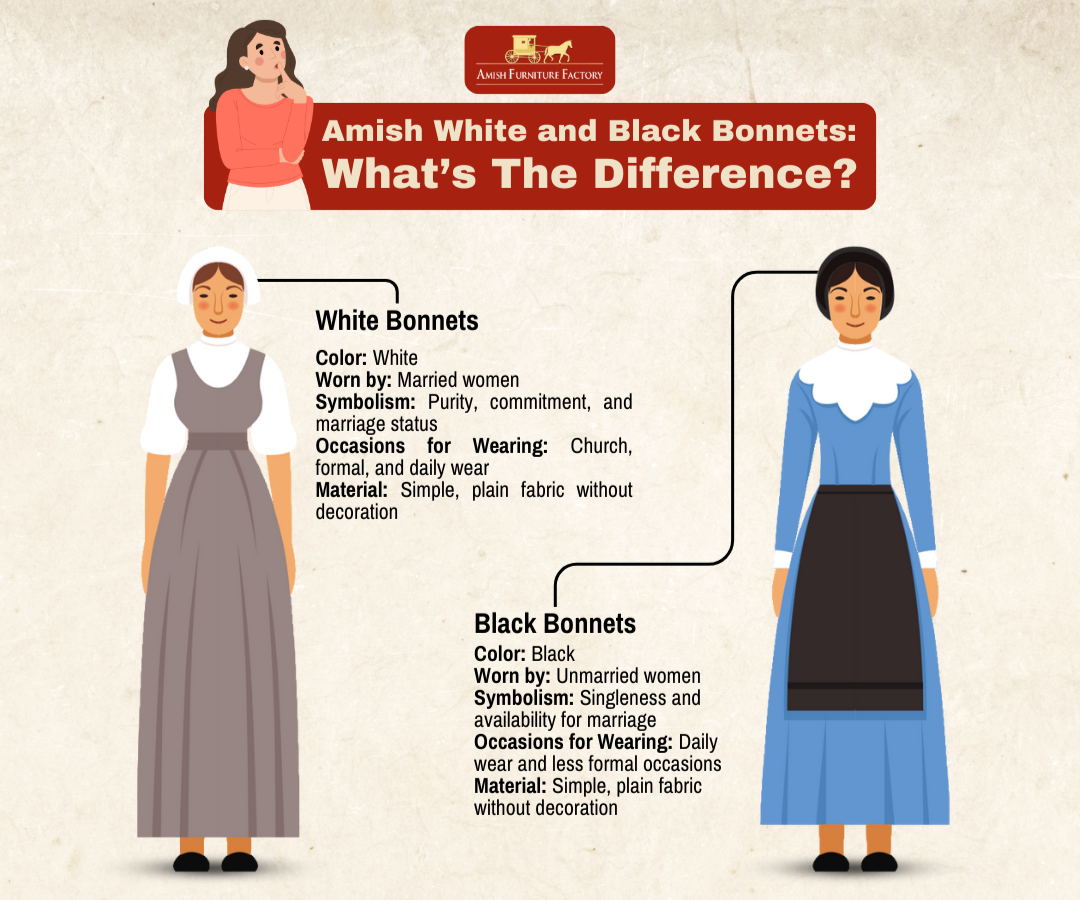
The kapp, or prayer covering, was the most visible part of a woman’s daily dress. Unmarried girls and women wore black kapps. Married women wore white. The color told the community your marital status without needing words or rings. I wore black until I married Sam at twenty. The day I tied on my first white kapp felt like crossing a threshold. It marked me as a wife, soon to be a mother.
The kapp was tied under the chin with strings. It covered my hair completely, which we never cut. Biblical teaching about head coverings shaped this practice. For me it became both a comfort and, later, a quiet weight. It reminded me constantly of my place in the order of things—submission, modesty, and faith. During my teenage years, when I participated in traditional courtship and bundling practices with young men from our community, including the early conversations that led to my marriage with Sam, the kapp was always there. It framed every interaction with clear boundaries.
My closest friend Ruth Stoltzfus and I sometimes helped each other adjust our kapps before youth gatherings. We shared small secrets about the boys we noticed—Eli Stoltzfus, Daniel Beiler, and others whose names still bring a faint smile. The black kapps we wore then felt like a shared uniform of waiting and wondering.
After I left, setting the kapps aside was one of the hardest physical acts. I kept one white kapp for a long time, tucked away. It reminded me of the woman I had been and the faith I still carry, even if the form has changed.
Long Dresses, Aprons, and the Work of Women’s Hands
Amish women’s dresses were long, covering the shoulders, arms, and legs. They were usually solid colors—blue, purple, green, or brown in our Lancaster community. An apron, almost always white, was tied over the dress for work. It protected the fabric while baking, gardening, quilting, or caring for children. My mother’s aprons always carried the faint smell of flour or garden soil.
I learned to sew my own clothes as a girl. Sitting with my mother and later with quilting friends like Miriam King, I stitched seams that had to be strong and neat. The dresses were not tight or revealing. They were made for movement and work. In summer they could feel warm, but we accepted that as part of the life we chose.
A cape, often black, was worn over the shoulders for church or cooler weather. It replaced jackets, which were seen as too masculine. No pants or jeans for women. The division between men’s and women’s clothing was clear and intentional.
When I left at twenty-eight, choosing my first pair of jeans felt strange and freeing at the same time. I had never worn anything that showed the shape of my legs. Michael Carter, the kind friend I had known since I was eighteen, helped me navigate those early shopping trips without judgment. He understood that every new garment carried emotional weight.
Today I often choose simple, modest clothes that still echo the values I grew up with—practical, comfortable, nothing flashy. But I also let color and personal preference guide me in ways I never could before. Watching my daughter Emma pick out bright drawings and sometimes bright clothes of her own brings me quiet joy. She has choices I did not have at her age.
Men’s Clothing: Broadfalls, Hats, and Beards
Men in our community wore plain shirts, usually long-sleeved, and broadfall trousers held up by suspenders rather than belts. The trousers had a distinctive front flap fastened with hooks and eyes. Colors stayed neutral—blue, brown, gray. My father Jacob’s work clothes showed the honest wear of farming. My brother Samuel’s looked much the same. David, as a carpenter, sometimes had wood shavings caught in the fabric.
Married men grew full beards and did not cut them. Mustaches were avoided because of their historical association with military officers. My husband Sam wore his beard proudly after our marriage. It was part of his identity as a married man and a respected member of the church. Unmarried men remained clean-shaven.
Wide-brimmed straw hats protected men from the sun during long days in the fields. In church or during prayer, hats came off. Coats often had no buttons, a choice rooted in pacifist convictions that avoided anything resembling military uniforms.
These garments were practical for the work our men did. They also reinforced clear roles and a visible commitment to the community’s way of life. Sam believed strongly in these traditions. Our differences on other questions eventually grew, but I never doubted his sincerity in wanting to live faithfully according to what he had been taught.
Children’s Clothes and the Freedom I Now Give My Own
As a child I wore smaller versions of the same modest dresses and aprons the women wore. My hair was never cut, and a small kapp or covering was part of my daily dress from an early age. My brothers wore scaled-down versions of men’s trousers and shirts. Clothing for children emphasized practicality and early training in modesty and simplicity.
My own children, Emma and Ethan, live in a different world. Emma loves bright colors and patterns in her drawings and sometimes in her clothes. Ethan prefers sturdy play clothes he can get dirty while helping with small chores or running outside. I do not dress them in plain garb, but I do teach them about the clothing their grandparents and I once wore. I want them to understand the heritage without feeling bound by every rule.
I tell Emma that her body is good and that she can choose clothes that feel comfortable and joyful. I also share stories of the kapps and aprons that marked the women in our family. The goal is not to recreate the past but to give her both roots and freedom.
Footwear, Accessories, and the Things We Did Not Wear
Many Amish children went barefoot in summer. It was practical and, some said, kept us humble and connected to the earth. I remember the feeling of warm dirt or cool grass under my feet during play or chores. Adults often wore sensible black shoes or boots. Women wore plain black pumps with stockings under their long dresses.
Jewelry was forbidden, including wedding rings. Marital status was shown through the kapp color for women and the beard for men. No makeup, no earrings, no watches or handbags meant to draw attention. Sunglasses and other accessories were rare. The focus stayed on function and humility rather than ornament.
When I left, learning to wear even simple jewelry or choosing a watch felt like exploring a new language. Some days I still prefer the simplicity I grew up with. Other days I enjoy small expressions of personal style that once felt impossible.
The Deeper Meaning Behind Every Seam
Amish clothing was never only about fabric. It was theology you could wear. Modesty protected purity and kept attention on the heart rather than the body. Uniformity reduced competition and pride. Separation from changing fashions reminded us daily that we had chosen a different path.
The Ordnung dictated colors, styles, and fastenings in detail. Hook-and-eye closures instead of zippers or buttons in many cases. No velcro in stricter communities. Everything was meant to avoid worldliness and keep us focused on faith, family, and community.
I still value much of what those clothes taught me. They trained me in humility and practicality. They connected me to generations of women who sewed and worked and prayed in similar garments. At the same time, I eventually felt the weight of rules that left little room for personal conviction or a woman’s own sense of how faith should look in her daily life.
Leaving did not mean rejecting every value. It meant choosing which ones I would carry forward and which ones no longer fit the person I was becoming.
The Day the Clothes Changed
When I made the decision to leave at twenty-eight, I also made the decision to change how I dressed. It was not a small thing. Those garments had been my identity for almost three decades. Setting them aside felt like shedding a second skin.
I remember the mix of grief and relief the first time I chose a simple blouse and skirt that did not reach my ankles. There was guilt—had I abandoned something sacred? There was also a quiet excitement about discovering who I might be without the uniform of belonging.
Michael Carter helped me through those early weeks and months with steady kindness. He never pushed me to become someone new overnight. He simply walked beside me while I learned how to move through a world of choices I had never been taught to navigate.
Today my closet holds a range of clothes. Some days I reach for the simplest, most modest pieces that still echo my upbringing. Other days I enjoy color or a small accessory that once would have been forbidden. The freedom to choose is something I do not take for granted.
What I Hope My Children Will Understand
Emma and Ethan will grow up with more options than I had. I want them to know the stories behind the clothing their mother once wore every day—the kapps that marked stages of life, the aprons that protected dresses during honest work, the practical garments that kept our community visibly united.
I also want them to know they are free to ask questions about why things were done a certain way and whether those reasons still serve them. Faith, for me, is no longer based on fear of breaking rules. It is rooted in love, in the values of simplicity and community that I still hold, and in the courage to keep growing.
Emma’s drawings sometimes include colorful dresses and bright kapps mixed with her own imagined worlds. I smile when I see them. She is already blending heritage with imagination, and that feels like a gift.
An Honest Invitation
If you have ever wondered what Amish people wear and why, I hope this reflection has given you more than a description. The clothing was practical, symbolic, and deeply tied to identity. It shaped how we moved through the world and how the world saw us.
It also could not contain every question or every person. For some of us, the day came when we needed to choose different garments—both literally and in the deeper sense of how we live our faith.
I still honor the women who sewed those dresses and tied those kapps with love and conviction. I honor the men who wore their plain clothes and beards as visible commitments. And I honor the path that led me to new clothes and a wider understanding of what faithfulness can look like.
My life motto has not changed: “The hardest journey wasn’t leaving the Amish community. It was learning who I was after I left.”
If you are reading this because you are curious, because you are wrestling with your own questions about tradition and belonging, or because you are walking alongside someone who is, I am glad you are here. These stories belong to all of us who are trying to live with both roots and honesty.
Thank you for walking through this reflection with me. May your own journey, whatever it holds, be marked by grace, courage, and the freedom to keep becoming.


.png)
